
All afternoon I have been thinking about the impact of Cargill and the soy industry on this region. Perhaps these musings of mine partly contain a sense of guilt about my participation in the degradation of the Amazon. After all, I drink soy milk rather than cow's milk. Indeed I raised Hope to be a soy milk drinker rather than a cow's milk drinker beginning when she was an infant. Typically we purchased our soy milk by the case from the Costco off of Highway 99. Now I am wondering where that soy originated. Did the milk we drank in Elk Grove come from the plant here in Santarem, Brasil? I don't know, but I am going to try to find out!
In the mean time, here are some resources on the issue of deforestation. All of these titles are from the Los Rios catalog.
Barbosa, Luiz, C. The Brazilian Amazon Rainforest : Global Ecopolitics, Development, and Democracy. Lanham, MD : University Press of America, 2000.
Le Breton, Binka. The Greatest Gift : The Courageous Life and Death of Sister Dorothy Stang.
New York : Doubleday, 2007.
London, Mark and Brian Kelly. The Last Forest : The Amazon in the Age of Globalization.
New York : Random House, 2007.
Margolis, Mac. The Last New World : The Conquest of the Amazon Frontier. New York : Norton, 1992.
Millard, Candice. River of Doubt : Theodore Roosevelt's Darkest Journey. New York : Doubleday, 2005.
There are a couple other titles from the 1980s, including a video. Obviously the information in them would be obsolete but they may serve as prescient reminders of present realities. We can know the future when we listen to the voices.
09 February 2009

In Country: Santarem

After taking the overnight boat down the Amazon River we have arrived in Santarem, a small city (population about 300,000) which sits at the juncture between the Rio Amazonas and the Rio Tapajos. Indeed the waters from the two rivers, although they flow  side by side, do not mix. The water from the Rio Amazonas is a muddy brownish color and comes from high up in the Andes. The water from the Rio Tapajos is blue-ish in color and warmer. The locals call this the "meeting of the waters."
When we initially arrived in Santarem, our boat pulled up adjacent to a huge port and industrial shipping operation. It did not look like anything we had seen closer to the city, or at any of the stops on the way down the river. The sign near the port read "Cargill." After doing some research I have discovered that Cargill is a U.S. based corporation which set up this soybean shipping port on the west side of the city. Although initially the locals were receptive to the construction of the port because they thought it would bring good jobs to the region, recently the port and Cargill have fallen out of favor. Apparently there has been an ongoing court case at the federal level against Cargill for not getting the necessary environmental impact clearances. The following links offer more information about the conflict. http://www.cargill.com/news/issues/issues_greenpeacereport.pdf and http://www.greenpeace.org/international/news/soya-blazes-through-the-amazon
In the States we often hear about how the Amazon rainforest is being burned to make way for cattle and other crops. As I am realizing, that is no longer an abstraction. It is real and it is happening right here in this community.
Because of the legal action against Cargill, a moratorium against further deforestation has been imposed. However that does not prohibit the cultivation of lands that have already been deforested, nor does it stop the building of roads into the forest. The following is an interesting article with a visual about the environmental deterioration in the region. http://www.greenpeace.org.uk/blog/forests/impacts-amazon-soya-are-shown-map-20090119
Other sources: http://digitalcollections.sit.edu/isp_collection/249/
http://ran.org/what_we_do/rainforest_agribusiness/spotlight/case_studies/cargill_in_santarem/
http://ran.org/what_we_do/rainforest_agribusiness/spotlight/case_studies/cargill_in_santarem/
 side by side, do not mix. The water from the Rio Amazonas is a muddy brownish color and comes from high up in the Andes. The water from the Rio Tapajos is blue-ish in color and warmer. The locals call this the "meeting of the waters."
When we initially arrived in Santarem, our boat pulled up adjacent to a huge port and industrial shipping operation. It did not look like anything we had seen closer to the city, or at any of the stops on the way down the river. The sign near the port read "Cargill." After doing some research I have discovered that Cargill is a U.S. based corporation which set up this soybean shipping port on the west side of the city. Although initially the locals were receptive to the construction of the port because they thought it would bring good jobs to the region, recently the port and Cargill have fallen out of favor. Apparently there has been an ongoing court case at the federal level against Cargill for not getting the necessary environmental impact clearances. The following links offer more information about the conflict. http://www.cargill.com/news/issues/issues_greenpeacereport.pdf and http://www.greenpeace.org/international/news/soya-blazes-through-the-amazon
In the States we often hear about how the Amazon rainforest is being burned to make way for cattle and other crops. As I am realizing, that is no longer an abstraction. It is real and it is happening right here in this community.
Because of the legal action against Cargill, a moratorium against further deforestation has been imposed. However that does not prohibit the cultivation of lands that have already been deforested, nor does it stop the building of roads into the forest. The following is an interesting article with a visual about the environmental deterioration in the region. http://www.greenpeace.org.uk/blog/forests/impacts-amazon-soya-are-shown-map-20090119
Other sources: http://digitalcollections.sit.edu/isp_collection/249/
http://ran.org/what_we_do/rainforest_agribusiness/spotlight/case_studies/cargill_in_santarem/
http://ran.org/what_we_do/rainforest_agribusiness/spotlight/case_studies/cargill_in_santarem/
05 February 2009
In Country: Manaus
This city is an armpit. Over 2 million people huddle into this squalid (and once glorious) city in the middle of the jungle. At every street corner a scammer crouches waiting to pounce on an unsuspecting tourist. Crafty men known as touts offer Amazon tour packages at inflated prices. The art of negotiation serves as the capstone for every transaction. The streets are narrow and clogged with vendors, their carts and wares. Each morning it rains, the warm water accompanied by thunder and lightning. We are in the midst of the jungle, and it is a desperate and unpleasant place.
Last night, after surveying the situation we decided to get out of here as soon as possible. Therefore in a couple hours we will hop on a boat headed down the Amazon. The boat ride takes 36 hours and there will be no internet access. As soon as I have connectivity again I will post about our experiences. Until then, eat some vegetables for me.
Last night, after surveying the situation we decided to get out of here as soon as possible. Therefore in a couple hours we will hop on a boat headed down the Amazon. The boat ride takes 36 hours and there will be no internet access. As soon as I have connectivity again I will post about our experiences. Until then, eat some vegetables for me.
04 February 2009
In Country: Brasilian Blues
Okay, let me say this up front: I have flown in airplanes all my life. My father is a small aircraft mechanic who, for most of my childhood years, was also a small aircraft pilot. Family vacations often consisted of flying into remote regions, where my gregarious father seemed to know every mechanic, air tower operator, and flight instructor between Alaska and Mexico. I have also flown quite a bit as an adult, to Bangkok, Boston, London and Vancouver Island. You get the idea.
So, what's the point of talking about previous travel experiences in a blog about Brasil? Because last night was our first domestic air travel in Brasil and it was a doozy! To start, the flight left at 11:55pm (yep, that's almost midnight) and arrived in Manaus at 1:55am (yep, that's the middle of the night). Because we were traveling back in time (how Hollywood is that?), we lost two hours. In other words, we were in the air for 4 hours but arrived 2 hours after we had departed.
Time change I am used to but the next part is where it gets really weird. Our boarding pass said we were to board the plane at 10:55pm. That's a whole hour before departure. Despite the stated time on the boarding pass, we actually didn't board until about 11:30pm. Unfortunately then we sat in the airplane for a good 30 or 40 minutes. Why? Oh, I thought you would never ask! Because, oh wait, did I mention that we were departing Sao Paulo in the midst of a thunderstorm? Yep, that's right. We had to sit in the airplane because we were waiting for a lapse in the lightning that flashed all around us. Finally someone more experienced than I in determining when it's okay to fly during lightning storms decided we were ready to take off and so . . . up, up and away we went. Had the lightning stopped, you ask? Of course not! But we made our ascent with the flashing lights on the aircraft wings taunting the flashing electric storm in the sky.
While strapped into our seats awaiting departure, and perhaps to take our minds off the storm, the steward people passed around small pieces of candy and head phones. So I listened to Bruce Springsteen sing "Born in the USA" as the plane taxied down the runway, the engine gained speed and, suddenly, it occured to me that it sounded like . . . a small lawn mower. There we were sitting in a metal canister with an engine that sounded like David's yard equipment while enormous quantities of electrical energy stabbed the air around us. I may have been born in the USA, but surely I was going to die in Brasil.
Alas, it was not to be and we passed through the storm unscathed. The steward people turned down the lights and everyone sank into a shallow airplane slumber. And then, it happened! Without warning (or was that what the intercom voice had just said in Portuguese?) the cabin lights blinked on. Why? Because surely you must know that at 1:00am in the morning everyone needs to eat chicken, rice, salad and a coconut dessert treat.
Like lemmings we dropped our tray tables, ordered our drinks and ate our dinner in the middle of the night. Unfortunately, then the steward people forgot about us. Half eaten dinner rolls, empty drink cups, and greasy dressing packets sat before us on a bed of crumpled tin foil and saran wrap coverings. Indeed, we were left with dinner remnants on our tray tables for oh, about an hour as we shifted and squirmed to get comfortable in the reduced space. Just try getting up to use the restroom if you are on the window and have three open tray tables between you and the aisle.
Finally relief came when the steward people removed our dinner remains and the cabin lights were dimmed. Sleep and the hum of the lawn mower. A woman snored. Hope, in her sleep, kicked the man sitting next to her. Desculpe.
I wallowed into slumber with Hope's head buried in my lap. Then I awoke. The cabin was stifling hot. Sweltering hot. Choking hot. Did I mention it was hot? I glanced at David across the aisle. He was gasping for air. Poor guy.
Suddenly, the lights came on. In Portuguese the intercom voice told us the plane would land in 13 minutes. Cold air flooded the cabin. I could breathe.
The plane nosed down onto the tarmac in one of the softest landings I've experienced in a long time and we had arrived in Manaus: the Amazon.
So, what's the point of talking about previous travel experiences in a blog about Brasil? Because last night was our first domestic air travel in Brasil and it was a doozy! To start, the flight left at 11:55pm (yep, that's almost midnight) and arrived in Manaus at 1:55am (yep, that's the middle of the night). Because we were traveling back in time (how Hollywood is that?), we lost two hours. In other words, we were in the air for 4 hours but arrived 2 hours after we had departed.
Time change I am used to but the next part is where it gets really weird. Our boarding pass said we were to board the plane at 10:55pm. That's a whole hour before departure. Despite the stated time on the boarding pass, we actually didn't board until about 11:30pm. Unfortunately then we sat in the airplane for a good 30 or 40 minutes. Why? Oh, I thought you would never ask! Because, oh wait, did I mention that we were departing Sao Paulo in the midst of a thunderstorm? Yep, that's right. We had to sit in the airplane because we were waiting for a lapse in the lightning that flashed all around us. Finally someone more experienced than I in determining when it's okay to fly during lightning storms decided we were ready to take off and so . . . up, up and away we went. Had the lightning stopped, you ask? Of course not! But we made our ascent with the flashing lights on the aircraft wings taunting the flashing electric storm in the sky.
While strapped into our seats awaiting departure, and perhaps to take our minds off the storm, the steward people passed around small pieces of candy and head phones. So I listened to Bruce Springsteen sing "Born in the USA" as the plane taxied down the runway, the engine gained speed and, suddenly, it occured to me that it sounded like . . . a small lawn mower. There we were sitting in a metal canister with an engine that sounded like David's yard equipment while enormous quantities of electrical energy stabbed the air around us. I may have been born in the USA, but surely I was going to die in Brasil.
Alas, it was not to be and we passed through the storm unscathed. The steward people turned down the lights and everyone sank into a shallow airplane slumber. And then, it happened! Without warning (or was that what the intercom voice had just said in Portuguese?) the cabin lights blinked on. Why? Because surely you must know that at 1:00am in the morning everyone needs to eat chicken, rice, salad and a coconut dessert treat.
Like lemmings we dropped our tray tables, ordered our drinks and ate our dinner in the middle of the night. Unfortunately, then the steward people forgot about us. Half eaten dinner rolls, empty drink cups, and greasy dressing packets sat before us on a bed of crumpled tin foil and saran wrap coverings. Indeed, we were left with dinner remnants on our tray tables for oh, about an hour as we shifted and squirmed to get comfortable in the reduced space. Just try getting up to use the restroom if you are on the window and have three open tray tables between you and the aisle.
Finally relief came when the steward people removed our dinner remains and the cabin lights were dimmed. Sleep and the hum of the lawn mower. A woman snored. Hope, in her sleep, kicked the man sitting next to her. Desculpe.
I wallowed into slumber with Hope's head buried in my lap. Then I awoke. The cabin was stifling hot. Sweltering hot. Choking hot. Did I mention it was hot? I glanced at David across the aisle. He was gasping for air. Poor guy.
Suddenly, the lights came on. In Portuguese the intercom voice told us the plane would land in 13 minutes. Cold air flooded the cabin. I could breathe.
The plane nosed down onto the tarmac in one of the softest landings I've experienced in a long time and we had arrived in Manaus: the Amazon.
03 February 2009
In Country: Museo de Arte de Sao Paulo

Today is our last day in Sao Paulo. Late tonight we fly to Manaus, a city of 2 million people in the middle of the Amazonian jungle.
Before leaving Sao Paulo I wanted to catch one more museum so this morning Fernando, Hope and I headed for the Museo de Arte de Sao Paulo. Considered to be one of the best museums in Sao Paulo, this collection was started after World War II when Europe was in ashes and Brasil was emerging from dictatorship. Because of Europe's weakened state, Brasil was able to pick up paintings by some of the greatest European masters of all time including Picasso, Cezanne, Raphael, Bosch, Constable, Rodin, Monet, Manet, Van Gogh, and Tintoretto. We also managed to see a 2nd century C.E. sarcophagus carved in Rome and a 3rd century C.E. Roman copy of a Greek statue of Eros. Needless to say, this is an art lover's paradise and a world-class museum!
Hope is becoming a first rate museum-goer. Today she brought her notebook and pen and took notes of the paintings she liked. Unfortunately the museum did not allow photos inside so I couldn't capture images of the paintings or of my daughter studying them.
Fernando also enjoyed himself, although he did not know that it's not okay to touch the art work. When we first arrived and were looking at a huge portrait by Thomas Gainsborough he reached out and touched it saying something like "This is not original, right?" Aghast I explained that he can get in lots of trouble with the museum guards, who seemed to be everywhere, and that museum etiquette required that the artwork NOT be touched. We escaped without alarm bells ringing across the gallery. Perhaps I am hyper-sensitive because prior to going to the museum I had read that a couple paintings had been stolen from this museum in December 2007 and again in June 2008. As a result, the curator of the museum had vowed to enhance security measures in the facility, which may account for the number of guards we saw.
One last point about museums in Brasil. Since we have been here, I have viewed about 15 art collections at different museums around the country. And, except for two small museums in Ouro Preto where I paid one or two heis (less than $1 U.S.), all of the museums have been absolutely FREE. Now some of this is just lucky timing. For instance, the museum today is always free on Tuesdays. But some of it is because the Brasilian government and other philanthropists have decided to make the collections available to the public. And this is what seems remarkable! World class exhibits placed inside world class architecture available for viewing at rock bottom prices. Amazing.
Before leaving Sao Paulo I wanted to catch one more museum so this morning Fernando, Hope and I headed for the Museo de Arte de Sao Paulo. Considered to be one of the best museums in Sao Paulo, this collection was started after World War II when Europe was in ashes and Brasil was emerging from dictatorship. Because of Europe's weakened state, Brasil was able to pick up paintings by some of the greatest European masters of all time including Picasso, Cezanne, Raphael, Bosch, Constable, Rodin, Monet, Manet, Van Gogh, and Tintoretto. We also managed to see a 2nd century C.E. sarcophagus carved in Rome and a 3rd century C.E. Roman copy of a Greek statue of Eros. Needless to say, this is an art lover's paradise and a world-class museum!
Hope is becoming a first rate museum-goer. Today she brought her notebook and pen and took notes of the paintings she liked. Unfortunately the museum did not allow photos inside so I couldn't capture images of the paintings or of my daughter studying them.
Fernando also enjoyed himself, although he did not know that it's not okay to touch the art work. When we first arrived and were looking at a huge portrait by Thomas Gainsborough he reached out and touched it saying something like "This is not original, right?" Aghast I explained that he can get in lots of trouble with the museum guards, who seemed to be everywhere, and that museum etiquette required that the artwork NOT be touched. We escaped without alarm bells ringing across the gallery. Perhaps I am hyper-sensitive because prior to going to the museum I had read that a couple paintings had been stolen from this museum in December 2007 and again in June 2008. As a result, the curator of the museum had vowed to enhance security measures in the facility, which may account for the number of guards we saw.
One last point about museums in Brasil. Since we have been here, I have viewed about 15 art collections at different museums around the country. And, except for two small museums in Ouro Preto where I paid one or two heis (less than $1 U.S.), all of the museums have been absolutely FREE. Now some of this is just lucky timing. For instance, the museum today is always free on Tuesdays. But some of it is because the Brasilian government and other philanthropists have decided to make the collections available to the public. And this is what seems remarkable! World class exhibits placed inside world class architecture available for viewing at rock bottom prices. Amazing.
02 February 2009
In Country: Sao Paulo Street Scenes
This church sits in Praca da Se (known as Cathedral Square), which is considered to be the heart of the oldest part of Sao Paulo. The church is called Catedral da Se and is the seat of the Roman Catholic Archdiocese in the city. This particular building took over 40 years to be constructed, beginning in 1913. The architectural style is known as neo-Gothic with its tall spires, pointed arches over the windows and on the tympanum, and extensive use of stained glass. It is, however, a 20th century invention which is what earns it the "neo" (meaning new) designation.
 Although this structure was built within the last 100 years, the church site has a long history. In 1589 Jesuits Manuel da Nobrega and Jose' de Anchieta made an arrangement with the local indigenous leader, a guy by the name of Tibirica', to establish a small church in the village. Since then the church site has been retained even though the church itself has been torn down and rebuilt multiple times. Today it is the largest church in Sao Paulo.
 Although this structure was built within the last 100 years, the church site has a long history. In 1589 Jesuits Manuel da Nobrega and Jose' de Anchieta made an arrangement with the local indigenous leader, a guy by the name of Tibirica', to establish a small church in the village. Since then the church site has been retained even though the church itself has been torn down and rebuilt multiple times. Today it is the largest church in Sao Paulo.
 At the other end of the Cathedral Square sits this statue to honor Jose' de Anchieta, one of the Jesuit missionaries who came from Spain at the age of 19 to convert the inhabitants of the New World. He is also considered to be the founder of Sao Paulo and a prolific writer. Many call him the father of Brasilian literature, although I can't figure out why he's not considered a Spanish writer in South America.


Construction on the Theatro Municipal began in 1903. Today this structure hosts classical music and operatic performances yet it, like the Catedral da Se above, are in really seedy parts of town. Although not depicted well in these photos there are clusters of street kids, drug addicts and even homeless families using these historic buildings as their neighborhood. If you look closely you can see a man in a green shirt laying on the ground just below the statue of Jose' de Anchieta.  Although David is in the foreground, behind him in the distance is a homeless family laying under the tree. We encountered several of them in this part of the city. Take away lesson: Sao Paulo is a hard city to live in if you are poor.

Although David is in the foreground, behind him in the distance is a homeless family laying under the tree. We encountered several of them in this part of the city. Take away lesson: Sao Paulo is a hard city to live in if you are poor.
Because we were here on a Sunday afternoon, the crowds along this avenue were relatively light. This is a side view of the Theatro Municipal.
 To the west of the Praca da Se is another plaza known as the Praca de Republica. On Sundays a faire hippie is held here with lots of artisan crafts, clothing, shoes, and jewelry. This building, one of Oscar Neimeyer's designs with its characteristic curves, sits just across the plaza.

To the west of the Praca da Se is another plaza known as the Praca de Republica. On Sundays a faire hippie is held here with lots of artisan crafts, clothing, shoes, and jewelry. This building, one of Oscar Neimeyer's designs with its characteristic curves, sits just across the plaza.


01 February 2009
In Country: Pousada Dona Zilah
We have been staying at the Pousada Dona Zilah in the Jardim (garden) District of Sao Paulo. This is a toney neighborhood southwest of downtown. The first two nights were a bit unpleasant because we were placed in a noisy room directly facing the street, which is busy, and with beds that seemed to be alive with animals, which were bed bugs. Gross, I know.



So I asked (twice) to be moved and my persistence paid off as last night we got a good night's sleep, thankfully in a room relatively free of insects. The staff here are pleasant enough, although they have a habit of acting like they only speak Portuguese and then, in the middle of a raggedy conversation in which I am botching every single verb conjugation possible, they break into English. "Ohhhh, you speak English," I say in relief. Invariably, the staffer just nods with a slight smile. Perhaps they enjoy watching an American squirm. From their perspective, I am sure it is very funny since my Portuguese is really bad. I am talking muito malo.
As for the neighborhood, David claims to hate it. It's too swanky for him. I choose it, however, because the guide book I'm using (Lonely Planet Brazil) says Sao Paulo is dangerous, and I didn't want to lose my shirt, my daughter or my life in this city. Hence, we're situated in swank. And it's about as different from the favelas of Belo Horizonte as any neighborhood could be. The ultra-rich who live here fly helicoptors to work rather than drive. You think I'm kidding? Check this out: http://www.ainonline.com/news/single-news-page/article/sao-paulo-the-worlds-helicopter-capital/ .
And I have just learned of a newly published novel entitled Heliopolis by James Scudamore which illuminates those differences. Unfortunately books written in English are hard to come by in Brasil and I have not read much Brasilian literature since I arrived. I have scoured book stores in Belo, Campinas, Curitiba and Sao Paulo. If a book store has an English section, the titles are of the Danielle Steele ilk. And I have also scoured used book stores. In most cases, there is one lonely shelf dedicated to English titles. These, too, are often in the harlequin genre and, more often, conveniently placed next to pornography, which seems to diminish the pleasure in used book browsing, if you know what I mean.
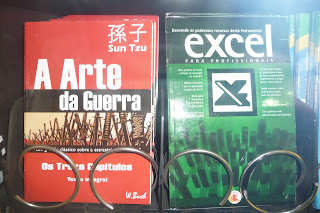
While I'm on the topic of books, I did encounter something pretty interesting today while using the subway: a vending machine which only sold books. There it was. William Shakespeare next to Excel manuals; the Brasilian Federal Constitution adjacent to Neitzsche. And they were pretty cheap, usually for less than $15 heis (about $7 bucks U.S.). Apparently the Lula government is really trying to emphasize literacy, and enabling the citizenry to select E7 for sonnets is one way to meet their objective. Alas, all of the titles were in Portuguese so I did not partake.


Subscribe to:
Posts (Atom)