
20 February 2009
In Country: Global Economic Downturn Effects Brasil Too
In the past two months, Brasil has lost 750,000 jobs as a result of the global economic crisis. And these are just the "formal" jobs registered with the federal government. Since many millions of people in Brasil work in unregistered jobs, we will never know the real impact of the economic slowdown. Informal jobs include street vendors selling pirated DVDs, beer, fruit and vegetables, and myriad other economic transactions that the government does not know about and views as illegal. While many here in Brasil don't even realize there is a global crisis (probably because life was hard even when the rich were flush with cash), the cloud gathering overhead suggests worse times are on the horizon.

16 February 2009
In Country: Pessoas, Pintadas e Palavras
As it is spoken in Brasil, the Portuguese language is lyrical and lovely. Although similar to European Portuguese (EP), there are some distinct differences in spelling, lexicon and grammar. This has to do with indigenous, African and British colonial influences upon the spoken word. Portuguese colonists may have brought the language to Brasil, but earlier inhabitants and other immigrants changed it into the unique language that it is today. Furthermore, although Brasil is the only country in the Western Hemisphere which speaks Portuguese, its historical relations with Britain and its close proximity to the United States probably explain why Brasilian Portuguese (BP) has absorbed considerably more words in the English language than EP. Take, for example, the English word "bus." In BP it is ônibus, or more commonly, unibus. Yet in Portugal it is autocarro. Another transportation-related example can be found in the English word "train." In BP it is trem, but in EP it is comboio.

In some ways it might be worth considering the language as representing points on a continuum. Going back in time, one could start with the painted pictures in the caves at Pedra Pintada.  Although we may not always know exactly what the earliest human inhabitants were saying, we know without question that their pictures are saying something to us. Our inability to interpret their picture words with any certainty is analogous to some of my conversations with Brasilians today. Because of my inability to de-code the language, it's auditory gibberish to me. Likewise with the pictures painted on the rocks by our Pleistocene brethren. In our 21st century inability to de-code the images, those 12,000 year old pictures are visual gibberish to us. We can guess what they are trying to tell us, just as I guess when Brasilians speak with me on the street, but often it is just that: a guess.
 Although we may not always know exactly what the earliest human inhabitants were saying, we know without question that their pictures are saying something to us. Our inability to interpret their picture words with any certainty is analogous to some of my conversations with Brasilians today. Because of my inability to de-code the language, it's auditory gibberish to me. Likewise with the pictures painted on the rocks by our Pleistocene brethren. In our 21st century inability to de-code the images, those 12,000 year old pictures are visual gibberish to us. We can guess what they are trying to tell us, just as I guess when Brasilians speak with me on the street, but often it is just that: a guess.
Moving forward through time, the Tupi people emerge as a distinct culture with a distinct language in the region. Actually there are hundreds of dialects of the Tupi language, some now extinct but some still persisting in the face of genocide and modernization. Perhaps the people who made the ceramics and funerary urns c. 5000 BCE spoke an early derivation of Tupi. It's likely.
With some imagination one can visualize Tupi men sharping stone blades and carving wooden statues, with hushed voices discussing crops, rain, and women as they labored late into the night. Likewise the women, working the dampened earth with their hands and shaping the earth into ceramic urns, would work as they discussed food, their children and men. Sometimes the women might break into laughter at a particularly funny story one told of a man, but the hands would continue to kneed the clay and the words would continue to ebb through the task. All this in a language which we will never hear but which we can catch a glimpse into by looking at the objects those men and women left behind.

Fast forward again to the first Europeans who washed up on Brasilian shores. They brought with them other languages, more words than the Tupi could have ever imagined along with weapons superior to the stone tools which had been in use for thousands of years. But, as with the confluence of rivers which may run side by side for miles without mixing but then ultimately do, there was a cross fertilization of words, ideas and labors between the Tupi and their interlocutors. For several decades in the 16th century the two civilizations inhabited parallel lives, human rivers which flowed side by side but seldom mixed. Eventually, though, the Tupi learned European words and European weaponry. So, too, did the Europeans learn Tupi words and Tupi foods. The rivers merged to form a new language, sprinkled with Portuguese, English, Spanish and the words of the newest arrivals, the unlucky people from Angola and the Gold Coast of Africa. It is not a pure Tupi, nor is it a pure Portuguese that is spoken in Brasil. Too many other rivers have met at this confluence.
With the speed of light on our journey through language we move forward into the 21st century. Techology once again changes the method and the medium of communication. An ironic example can be found during my excursion into the jungle to visit the cave paintings. Several times our guide, Nelsi, received calls on his cell phone. So there I am studying 12,000 year old paintings -- the only communication we have in a one-way conversation with our Pleistocene forefathers-- and my guide is talking on his cell phone. The beauty of the moment may be beyond words. Yet that is what we have: communication. Whether in pictures or words, whether ancient or recent, whether by petroglyph or cell phone, the most profound element to being human is our ability to communicate.
15 February 2009
In Country: Pedra Pintada
 Our goal for traveling to Monte Alegre was to meet up with a guide and a driver who would take us to visit a series of caves in the region. Excavated over a span of three years by the prominent archaeologist Anna C. Roosevelt, the caves are significant because they contain the "oldest firmly dated examples of art in the Western Hemisphere" (Wilford). Roosevelt lived in Monte Alegre while she worked at Caverna da Pedra Pintada (Cave of the Painted Rock), the most well-known of the four caves we visited.
Early Friday morning we met our guide and his driver, Nesli and Carlos, who picked us up in a sturdy green diesel 4-wheel Toyota pick up.
 The trip to the caves took about an hour and consisted of driving along dirt and sand tracks through the jungle.
A couple of times we saw evidence of deforestation, in the form of recently burned tracts of land adjacent to an individual farmer's thatched roof house. It was clear that the land was being cleared either for crops such as corn or soy, or to make room for the ubiquitous herds of cow (and in this case, water buffalo) that we encountered several times along the way.


We also saw evidence of human intervention with the landscape. Notice the rectangular shape carved out of the jungle in the middle of this photo frame.  While not as noticeable when on the ground, this view from a rocky outcrop above the jungle canopy vividly displays the ways in which humans manipulate the land to meet human needs. It's this last point that Roosevelt postulates so controversively as a result of her excavation at Pedra Pintada. In a 2000 interview with the Society for California Archaeology, she claims that "indigenous peoples have access to the knowledge that their interaction with environments is a kind of co-evolution . . . People adapt to environments but they also change them. There are no virgin environments on earth in areas where people lived." If Roosevelt's theory is correct, then the popular idea that the Americas -- north and south -- were pristine wildernesses prior to European colonization is merely Euro-centric mythmaking. This makes Roosevelt a diffusionist of the first order.
But Roosevelt's challenge to conventional thinking about pre-contact land use does not stop here. She also claims that the indigenous people of the Lower Amazon basin were interacting with the very ground on which they walked. In other words, the people were performing a complicated gardening technique whereby they were creating a unique type of soil known as terra preta (black earth). Perhaps the best way to describe her idea is to consider the backyard compost pile. By adding coffee grounds, egg shells and other organic matter to the ground in your own backyard, you can create a new soil which is full of nutrients and very fertile. This rich, new soil can be added to your garden to enhance plant growth. In short, it's a home grown fertilizer.
This, then, is what Roosevelt claims the people of this region were doing: terraforming their environment to enhance a naturally weak and unstable jungle soil in order to maximize cultivation. And her evidence is compelling. Throughout most of Brasil we have encountered red earth. Indeed the road on which we traveled was mostly red, as evidenced by the photo with the water buffaloes. However when we arrived in the vicinity of the caves where the earliest inhabitants lived, the soil changed. It was black, loose and seemingly very fertile. The ground was unlike any I have seen in any other part of this region or the country, for that matter.

So, who were the people of Pedra Pintada? Based on the Carbon 14 dating of the objects excavated at the caves, the people definitively lived here between 10,500 - 10,300 BCE. It is likely that they were here before and after those dates too, but the science pegs the material record to this 300 year range. According to Roosevelt, they "gathered nuts and fruits, fished and collected shellfish, turtles, tortoises, and frogs and caught small animals, not big game." This point, too, is important. Traditionally, mainstream archaeology claims that the Clovis model (big game hunters who lived about 11,000 years ago) were the only human inhabitants of the Americas. Yet the evidence from this region refutes this theory. In the words of Roosevelt, Pedra Pintada "showed a different and somewhat unexpected type of terminal Pleistocene culture" which was a "much more heterogeneous Paleoindian culture than envisioned in the Clovis model." Apparently the inhabitants were seasonal residents who used the caves for cooking meals, sharpening stones, sorting seeds and painting their world view. Rather than being the descendants of Clovis "they were contemporaries, with their own distinctive stone technology and art and a foraging way of life suited to their forest and riverine habitat" (Wilford). Some of the paintings they made are of clearly recognizeable shapes: birds, people, fish. Obviously they depicted the every day objects of the world in which they lived. Other images are zoomorphic and other worldly, with likely spiritual meanings and originations.


 Nelsi, our guide, suggested that the image above is a calendar. It contains 51 boxes, which roughly corresponds to weeks of the year. On the rock adjacent to this image is the photo above it, which Nelsi claims depicts 9 planets and a shooting star. The human form to the left of the constellation is a woman giving birth. There were several child birthing images at three of the four cave sites. This suggests to me the importance of a woman's role in ensuring the survival of the species.

Maureen, sweaty and happy in the jungle.

 Nelsi, our guide. Apparently he was the one who brought Anna Roosevelt to the caves when she first arrived in the region in 1991.

 Nelsi, our guide. Apparently he was the one who brought Anna Roosevelt to the caves when she first arrived in the region in 1991.
Sources:
Wilford, John Noble. "Scientist at Work: Anna C. Roosevelt; Sharp and To the Point In Amazonia." New York Times. April 23, 1996. http://query.nytimes.com/gst/fullpage.html?res=9E07EFD91F39F930A15757C0A960958260&sec=&spon=&pagewanted=1
Interview with Anna C. Roosevelt, 2000. Society for California Archaeology. http://scahome.org/about_ca_archaeology/2000_Roosevelt.html
In Country: Swaying with Strangers
You have probably heard of swinging with strangers, but our most recent experience takes that term to a new level. What, you might ask, is swaying with strangers? Basically it entails stringing up a hammock in the belly of a boat while floating down the mighty Amazonas River.  The hammocks are strung quite close together and create a lovely mosaic pattern of colors and shapes. And, if you are really lucky, you might enjoy having a complete stranger kick you in the head free of charge. Tudo bem.


 The hammocks are strung quite close together and create a lovely mosaic pattern of colors and shapes. And, if you are really lucky, you might enjoy having a complete stranger kick you in the head free of charge. Tudo bem.

And so, swaying with strangers is what David, Hope, Fernando and I did on Thursday afternoon. We purchased three hammocks from the street market in Santarem before catching a medium sized boat headed east down the river. For about 6 hours we swayed in our hammocks as the boat sailed past isolated fishing villages and low lying riverine terrain before arriving at our destination, Monte Alegre (population 30,000).

This small city on the north bank of the Amazonas River sits adjacent to a geologic anomaly in the Lower Amazon basin. While most of the region is flat and rests at sea level, the area of Monte Alegre is relatively mountainous. Indeed, monte in Portuguese, Spanish and Italian refers to the word mountain and thus suggests the modest elevation gain of up to 350 meters around Serra Itauaiuri, its highest mountain.
It's probably also worth noting that the word alegre typically means happy. So after swaying with strangers we safely reached happy mountain.
11 February 2009
In Country: Plan B
This morning dawned hot, humid and booming with thunder showers. As a result we dropped our plans for a jungle excursion this morning, which gave Hope and I time to identify verbs from Steinbeck's Mice and Men. Hence today's activities represent Plan B, which later in the afternoon consisted of Fernando and I walking around Santarem while David and Hope took a nap.
Since we arrived in the Amazon last week, I have been trying to comprehend the enormity of this place and what it means to Brasil and the world. Obviously people spend their lives here and don't have a complete picture of its importance, so how could I possibly grasp it in just a handful of days? That said, in the brief time I have been here I have come up with a short list of what I think are the fundamental issues in the Amazon. In no particular order they are deforestation, oil extraction, the loss of traditional cultures, and environmental degradation.
Deforestation takes two forms in the Amazon. According to Robert Walker, deforestation occurs first at the individual level. A farmer cuts down the forest in order to plant crops for subsistence production that ensures his family's food security. This is the most basic level and has been occuring for thousands of years (Walker 377). William Balee, a Tulane University anthropologist suggests that "about 12% of the non-flooded Amazon forest was of anthropogenic origin - directly or indirectly created by human beings" (Mann 52). In other words, humans have been cultivating the forest for a very long time as a means of survival. Thus the individual farmer's cultivation of forest land is a very old and well established practice.
However, as market forces (commonly known as globalization) have penetrated Brasil that forest survival takes on new meaning and leads to the second level of deforestation. In this instance, multinational corporations (such as Cargill here in Santarem) encourage farmers to shift their cultivation practices from subsistence to commercial production. Typically this requires the farmer who once cultivated multiple crops to focus on a single plant species, a practice usually known as monoculture. In Santarem this explains the heavy reliance on soy and the shift away from jute, rubber and other agricultural products in the past 10 years.
According to Walker, however, the individual farmers and the multinational corporations are not the only players in this deforestation game. There are also loggers, gold miners and government bureaucrats who have a hand in the environmental changes taking place in the Amazon today. Farmers practice "invasive forest mobility" whereby they "follow loggers into newly opened forests" in an effort to put more newly deforested land into monoculture cultivation (Walker 378). More crops mean more money for the individual farmer. Furthermore, "80% of timber production from Amazonia comes from illegal logging" which suggests the blind eye bureaucrats must turn in exchange for cash to allow the practice to continue (Almanaque Brasil Socioambiental 2008).
There is another important aspect to the deforestation problem. As multinational corporations with all of their financial muscle acquire more land holdings in a region they force individual farmers off their land. These newly landless individual farmers become migrants who move into unclaimed -- and typically old growth -- portions of the forest in search of new lands to cultivate (Walker 378). The end result: more deforestation of the rainforest in an apparently endless cycle of cutting and cultivation, cutting and cultivation in the quest for the ever allusive dollar.
The second important issue on the list has to do with oil extraction. This is not a phenomena taking place in the lower Amazon. Rather it is occuring in the borderland region between Brasil and Ecuador. While I have not done too much research on it yet, I do know there is a legal battle being waged between the indigenous people and Texaco (Shell) http://www.npr.org/templates/story/story.php?storyId=94751411. A significant portion of the complaint the people have against Texaco is due to the impact oil extraction is having on traditional cultures and the consequent environmental degradation to the people and the land.
With regard to environmental degradation, there appear to be two types taking place on the river in the lower Amazon region. On the one hand, people along the Amazon realize that this river is special and worth preserving. On the other, the boats that serve as buses transporting thousands of people each week up and down the river dump their untreated toilet waste directly into the river. Yes. I saw it with my own two eyes. In addition, as we were underway on the river, individuals would casually toss their soda and beer cans into the river. Indeed the banks and beaches of the river are strewn with cans, bottles and plastic bags, along with the occasional sleeping pigs.
Furthermore, the sewer system is not very well developed here in Santarem or much of the Amazon region. Open sewer channels, known as open tubulation, run parallel to most sidewalks in town. Unfortunately their contents also flow directly into the river.
Lest one think that this photo depicts an isolated incident here is evidence to the contrary. According to an official government website,
"the North region of Brazil, principally the Amazon, presents the worst level of services of sanitation and infrastructure in the country, where only 2.4% of the houses have a sewer service and 13% access to water treatment. The infrastructure of Santarém is precarious for many neighborhoods, especially on the peripheral, outskirts of the city. Roughly 50% of the city’s residents have water treatment access and only 8% sewer service" (Santarém Municipality Website, 2007, page 3). Rather than being a rare event, this type of sewer drainage into the Amazon River is the norm. Hence the two part pollution problem: individuals and government both contribute to the environmental degradation of this amazing natural resource.
As I suggested earlier, the enormity of this place is almost incomprehensible. Yet, there are some know-able aspects to life in the Amazon. It is beautiful here, yet human agency seems to be engaged in a daily act of environmental destruction. It is valuable here, yet market forces seem to be pushing individuals to sell out rather than preserve its value.
Sources:
LOCALE CASE STUDIES: Santarém, Brazil. http://transact.marketumbrella.org/uploads/Brazil%20Research%20Files/trans%E2%80%A2act%20Final%20G-b%20Locale%20Case%20Study%20-%20Brazil.pdf
Mann, Charles C. “1491.” The Atlantic Monthly. Digital Edition. March 2002.
Walker, Robert. “Mapping Process to Pattern in the Landscape Change of the Amazonian Frontier.” Annals of the Association of American Geographers, Vol 93, No 2 (June 2003), pp 376-398.
Almanaque Brasil Socioambiental 2008. http://www.socioambiental.org/amazon/?q=amazon/history
Since we arrived in the Amazon last week, I have been trying to comprehend the enormity of this place and what it means to Brasil and the world. Obviously people spend their lives here and don't have a complete picture of its importance, so how could I possibly grasp it in just a handful of days? That said, in the brief time I have been here I have come up with a short list of what I think are the fundamental issues in the Amazon. In no particular order they are deforestation, oil extraction, the loss of traditional cultures, and environmental degradation.
Deforestation takes two forms in the Amazon. According to Robert Walker, deforestation occurs first at the individual level. A farmer cuts down the forest in order to plant crops for subsistence production that ensures his family's food security. This is the most basic level and has been occuring for thousands of years (Walker 377). William Balee, a Tulane University anthropologist suggests that "about 12% of the non-flooded Amazon forest was of anthropogenic origin - directly or indirectly created by human beings" (Mann 52). In other words, humans have been cultivating the forest for a very long time as a means of survival. Thus the individual farmer's cultivation of forest land is a very old and well established practice.
However, as market forces (commonly known as globalization) have penetrated Brasil that forest survival takes on new meaning and leads to the second level of deforestation. In this instance, multinational corporations (such as Cargill here in Santarem) encourage farmers to shift their cultivation practices from subsistence to commercial production. Typically this requires the farmer who once cultivated multiple crops to focus on a single plant species, a practice usually known as monoculture. In Santarem this explains the heavy reliance on soy and the shift away from jute, rubber and other agricultural products in the past 10 years.
According to Walker, however, the individual farmers and the multinational corporations are not the only players in this deforestation game. There are also loggers, gold miners and government bureaucrats who have a hand in the environmental changes taking place in the Amazon today. Farmers practice "invasive forest mobility" whereby they "follow loggers into newly opened forests" in an effort to put more newly deforested land into monoculture cultivation (Walker 378). More crops mean more money for the individual farmer. Furthermore, "80% of timber production from Amazonia comes from illegal logging" which suggests the blind eye bureaucrats must turn in exchange for cash to allow the practice to continue (Almanaque Brasil Socioambiental 2008).
There is another important aspect to the deforestation problem. As multinational corporations with all of their financial muscle acquire more land holdings in a region they force individual farmers off their land. These newly landless individual farmers become migrants who move into unclaimed -- and typically old growth -- portions of the forest in search of new lands to cultivate (Walker 378). The end result: more deforestation of the rainforest in an apparently endless cycle of cutting and cultivation, cutting and cultivation in the quest for the ever allusive dollar.
The second important issue on the list has to do with oil extraction. This is not a phenomena taking place in the lower Amazon. Rather it is occuring in the borderland region between Brasil and Ecuador. While I have not done too much research on it yet, I do know there is a legal battle being waged between the indigenous people and Texaco (Shell) http://www.npr.org/templates/story/story.php?storyId=94751411. A significant portion of the complaint the people have against Texaco is due to the impact oil extraction is having on traditional cultures and the consequent environmental degradation to the people and the land.
With regard to environmental degradation, there appear to be two types taking place on the river in the lower Amazon region. On the one hand, people along the Amazon realize that this river is special and worth preserving. On the other, the boats that serve as buses transporting thousands of people each week up and down the river dump their untreated toilet waste directly into the river. Yes. I saw it with my own two eyes. In addition, as we were underway on the river, individuals would casually toss their soda and beer cans into the river. Indeed the banks and beaches of the river are strewn with cans, bottles and plastic bags, along with the occasional sleeping pigs.

Furthermore, the sewer system is not very well developed here in Santarem or much of the Amazon region. Open sewer channels, known as open tubulation, run parallel to most sidewalks in town. Unfortunately their contents also flow directly into the river.

Lest one think that this photo depicts an isolated incident here is evidence to the contrary. According to an official government website,
"the North region of Brazil, principally the Amazon, presents the worst level of services of sanitation and infrastructure in the country, where only 2.4% of the houses have a sewer service and 13% access to water treatment. The infrastructure of Santarém is precarious for many neighborhoods, especially on the peripheral, outskirts of the city. Roughly 50% of the city’s residents have water treatment access and only 8% sewer service" (Santarém Municipality Website, 2007, page 3). Rather than being a rare event, this type of sewer drainage into the Amazon River is the norm. Hence the two part pollution problem: individuals and government both contribute to the environmental degradation of this amazing natural resource.
As I suggested earlier, the enormity of this place is almost incomprehensible. Yet, there are some know-able aspects to life in the Amazon. It is beautiful here, yet human agency seems to be engaged in a daily act of environmental destruction. It is valuable here, yet market forces seem to be pushing individuals to sell out rather than preserve its value.
Sources:
LOCALE CASE STUDIES: Santarém, Brazil. http://transact.marketumbrella.org/uploads/Brazil%20Research%20Files/trans%E2%80%A2act%20Final%20G-b%20Locale%20Case%20Study%20-%20Brazil.pdf
Mann, Charles C. “1491.” The Atlantic Monthly. Digital Edition. March 2002.
Walker, Robert. “Mapping Process to Pattern in the Landscape Change of the Amazonian Frontier.” Annals of the Association of American Geographers, Vol 93, No 2 (June 2003), pp 376-398.
Almanaque Brasil Socioambiental 2008. http://www.socioambiental.org/amazon/?q=amazon/history
In Country: Scenes from the Amazonas, Solimoes and Tapajos Rivers
Looking back I realize I did not post any pictures of our boat trip down the river. The following is a sample of some of the 300 photos I took on while on the Amazonas. 
Under an Amazon sky
Contrary to North American stereotypes of steep mountainous jungles tangling down to the river's bank (which is the case in the Andes), the Amazon basin here in Brasil is surprisingly flat. According to recent NASA satellite imagery, geographers have determined that the Amazon is 4,250 miles long. In addition most of the 2,900 miles that are located inside Brasil are at sea level, thereby making the landscape very flat. As a result there is a startling sameness to the sky, water and land.
Creative carrying capacity was on display in the harbor in Manaus. Note the bicycle, refrigerator and stove on this small lanche (motor boat), and the amazing ability of the men to heft huge items around like this guy carrying a full size refrigerator on his head!


A boat crewman waiting for passengers.
These boats are used like buses on the Amazon. Indeed, there are no roads that go from Manaus to Belem so the only way to get from the interior to the coast is by air or by boat. Hence the river functions as a roadway network. Typically the overnight boats are comprised of three decks. Locals string up their hammocks in the middle decks and sleep swinging in a common area that can be very crowded. 

Hope, assessing the life boat capacity on our boat.

Cooks, waiting for departure.
At the juncture of the Solimoes and Negro Rivers, the waters come together but do not mix. The Solimoes is muddy brown while the Negro is black, hence its name. Where they meet the waters swirl together in interesting shapes that look a lot like coffee con leite (coffee with milk).


And always the river and the sky.

Wildlife at the dock in Santarem

10 February 2009
In Country: Santarem and the Museum of Amazing Artifacts
This morning after breakfast Hope, Fernando and I headed out on foot to visit the Museu de Santarem. Housed in a yellow 19th century colonial building, this museum was free of charge and delightfully informal. We were met at the entrance by a young woman whose name was  barely pronounce-able to me and, unfortunately, I forgot to it write down.


 barely pronounce-able to me and, unfortunately, I forgot to it write down.
The building originally served as Santarem's version of the county courthouse, complete with the judge's chambers and a jail. Each room was separate and centered around a courtyard in the middle. The chamber that was most compelling to me contained indigenous artifacts including funerary urns, blow dart weapons, clubs, zoomorphic ceramics, arrowheads and other stone tools. Our guide claimed most of the stone and ceramic objects to be about 6,000 years old. The other articles including the war club are less than 100 years old. Unfortunately there was no provenance information on any of the articles aside from a brief plate identifying Santarem as the location. Regardless of the dearth of information, the exhibit was an incredible "find". In less than one hour I took about 100 photos. If, in this analogy, items can replace words then the objects presented here are haiku.
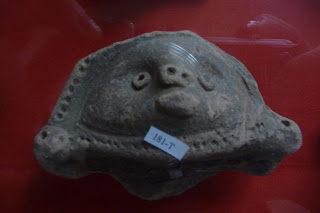


What's really interesting about these objects is that it appears very little research has been done on them. I was able to find references to only one book (in Portuguese) written in 2002 by an academic at the University of Sao Paulo and one master's thesis (in English) written in 1952 by a student in the U.S. Clearly lower Amazonian-region ceramics are a topic ripe for more research.
So, who were the people likely to have created these objects? Most accounts claim that the original inhabitants of this region were the Tupaius (now known as Tapajoas, like the river). Probably because of its convenient location at the juncture of two massive rivers, the Tupaius people settled a village here. It may have been a seasonal settlement or it may have been permanent one. Although no one questions its antiquity, there is a huge controversy in archaeological and anthropological circles right now about the type of settlement that formed here. Traditionally scholars have thought that the soils of the Amazon were too fragile to sustain anything more than mobile and small-sized hunter/gatherer communities. The main advocate for this line of thinking is a woman named Betty Meggers who has done quite a bit of research in this region as well as on an island closer to Belem. The scholars who identify with Meggers' theory are known as inventionists, and are generally considered mainstream academics. The basic idea behind their theory is that the peopling of the Americas occured gradually between 10,000 BCE (Before Common Era) - 3,000 BCE as a result of migrants walking across the frozen ice sheets between Siberia and Alaska during the last Ice Age. Anyone who has studied anthropology in the last 100 years has been taught this theory of human migration. The inventionists claim that the peopling of South America took place later than the peopling of North America simply because it took about 7,000 years for the migrants to move this far south.
On the other side of the controversy are the diffusionists. They are academics who are considered outside the mainstream because their ideas are not in line with the traditional theories about human migration. The diffusionists suggest that there may have been intentional contact between Pacific and Atlantic civilizations between 7,000-3,000 BCE. Basically diffusionists challenge traditional ideas about how and when the Americas (particularly South America) were peopled. One of the more prominent academics who could be called a diffusionist and who works in this region is Anna Roosevelt (yes, a distant relative of the two U.S. presidents). About 10 years ago she discovered petroglyphs in some caves across the river from Santarem. After performing over 50 carbon-14 dating tests on the paintings and other objects found there, she determined that humans inhabited this region as early as 10,000 BCE. Clearly this discovery throws the traditional theories on their ear.
Another important element about Roosevelt's discoveries at Caverna da Pedra Pintada has to do with the type of society the diffusionists believe early South Americans constructed. In short, Roosevelt postulates that the social formation consisted of "large, proto-state . . . interfluve forest societies" (Nugent). They weren't mobile, nor were they small according to Roosevelt. This, then, leads to another controversy about the type of soil in the region and the soil's ability to sustain a large-scale community.
While there are more questions than answers about the people who inhabited this part of the lower Amazon, one thing is for sure. The controversy about human migration, points of contact between civilizations, social formation and soil stability point to a redefining of our understanding of pre-historic America. In short, the story has not been fully told.
Most of the information on this topic can be found at http://www.theatlantic.com/issues/2000/01/001stengel.htm , http://www.theatlantic.com/doc/200203/mann , and http://www.sciencemag.org/cgi/content/full/275/5308/1948 .
The citation came from Nugent, Stephan. "The Amazon on Display: Unknown Amazon: Culture in Nature in Ancient Brazil." British Museum exhibit. June 2002. Anthropology Today. Vol 18, No 3, pp 21-22.
Subscribe to:
Posts (Atom)